Elvis Coimbra Gomes

PhD in Linguistics

My Teaching

Having grown up in Switzerland, and being the first in my family of Portuguese immigrants to have studied in higher education, I am especially attuned to the challenges students from national/ethnic minority groups can face. Academia is a strange world that requires one to adapt to an elitist culture, and learn its own specialized language. As such, I try as best as I can to:

  • speak in an accessible language when explaining complex concepts
  • maintain an interactive and supportive relationship with students
  • present concrete examples students can relate to when explaining theories
  • provide students with exercises where they can apply the learned methods
  • provide well-explained, illustrative, numbered power point slides containing all used references
  • encourage students to develop their critical thinking and communication skills
  •  provide criteria-based assessment grids containing constructive feedback that explicitly tell students how to improve
  • design assessments that develop their meta-cognitive awareness

My goal is to forge a community of mutual learners that do not get intimidated by the power dynamics between students and lecturers, but actively engage with what they learn. All of this, while creating a welcoming and respectful atmosphere for disadvantaged social groups (e.g., women, LGBT+ people, ethnic/national minorities, and people with disabilities).

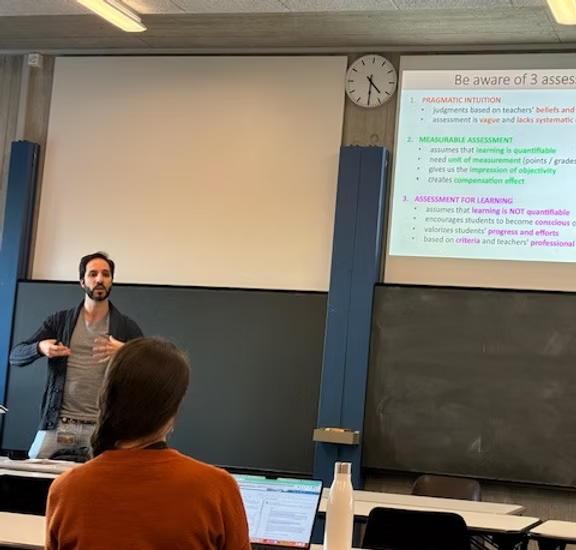
Ever since my teacher training at the Haute École Pédagogique de Vaud – especially after attending a module on assessment strategies taught by Prof. Raphaël Pasquini – I've been interested in developing methods to assess students at the university level. I mostly follow the paradigm of "assessment for/as learning" by providing students formative assessments or self-assessments where they can regulate their learning process when acquiring (inter)disciplinary and transversal skills. In order to get an idea of the kind of assessment grids that I promote, I can send you a PowerPoint document containing step-by-step instructions on how to create one. Just send me a mail with a request. 

Finally, when teaching English language, I tailor my lessons according to students' needs by drawing from different approaches (task-based language teaching, content and language integrated learning, present-practice-produce, etc.). My lesson planning is constantly structured around specific communication tasks that may occur in students' lives.

Teaching Experience

(A)= Autumn semester        (S) = Spring semester

Invited Guest Lectures / Workshops


  • Coimbra-Gomes, E. (2026). "Démarche d’évaluation dans l’enseignement de l’anglais". Pratiques d’enseignement et d’évaluation au service des apprentissages. Haute école pédagogique Vaud (Switzerland). 5 May. ​ 

  • Coimbra-Gomes, E. (2024). "Constructive Grading: Assessment Strategies for the English Department". University of Lausanne (Switzerland). 10 October. ​ 

  • Coimbra-Gomes, E. (2023). "Assessment Strategies for the English Department". University of Lausanne (Switzerland). 23 November. ​ 

  • Coimbra-Gomes, E. (2022). "Critical Discourse Analysis". Linguistic Research Methods. University of Lausanne (Switzerland). 2 December. ​ 

  • Coimbra-Gomes, E. (2017). "Introduction to Queer Linguistics and Its Application to Sexual Orientation OCD". Language & Gender. Venice International University (Italy). 3 April.

  • Coimbra-Gomes, E. (2017). "Applying Corpus Linguistics to Analyze CMC Discourse: a Very Brief Introduction". The Sociolinguistics of Cyberspace. Venice International University (Italy). 3 April.

  • Coimbra-Gomes, E. (2016). "Social Media and Corpus Linguistics in Health Communication: the case of Sexual Orientation Obsessive-Compulsive Disorder". Language and Social Media. University of Neuchâtel (Switzerland). 16 November.

  • Coimbra-Gomes, E. (2015). "Online Identity Creation". Language and Social Media. University of Lausanne (Switzerland). 10 November.
Search